
- 抑制剂
- 化合物库
- 抗体
- 生物试剂
- qPCR
- 2x SYBR Green qPCR Master Mix
- 2x SYBR Green qPCR Master Mix(Low ROX)
- 2x SYBR Green qPCR Master Mix(High ROX)
- 蛋白实验
- Protein A/G免疫沉淀磁珠
- Anti-DYKDDDDK Tag免疫磁珠
- Anti-DYKDDDDK Tag亲和凝胶
- Anti-Myc免疫磁珠
- Anti-HA免疫磁珠
- 磁力架
- Poly DYKDDDDK Tag多肽
- 细胞核与细胞浆蛋白抽提试剂盒
- 免疫磁珠
- 蛋白酶抑制剂Cocktail
- 蛋白酶抑制剂Cocktail(DMSO储液)
- 磷酸酶抑制剂Cocktail
- 新产品
- 联系我们

Adavosertib (AZD1775, MK-1775)
别名: AZD1775
Adavosertib (MK-1775, AZD1775)是一种有效的,高选择性Wee1抑制剂,无细胞试验中IC50为5.2 nM;阻碍G2期DNA损伤检验点。Phase 2。
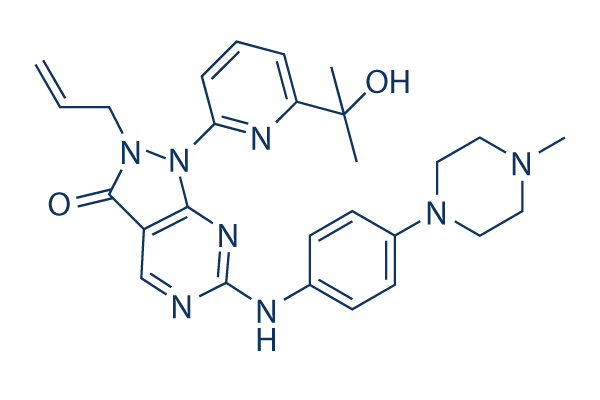
Adavosertib (AZD1775, MK-1775) Chemical Structure
CAS: 955365-80-7


产品质控
批次:
纯度:
99.99%
99.99
Adavosertib (AZD1775, MK-1775)相关产品
| 相关产品 | PD0166285 Zedoresertib (Debio-0123, WEE1-IN-5) Azenosertib (Zn-C3) | 点击展开 |
|---|---|---|
| 相关化合物库 | 激酶抑制剂库 PI3K/Akt 抑制剂库 MAPK抑制剂库 DNA损伤/ DNA修复化合物库 细胞周期化合物库 | 点击展开 |
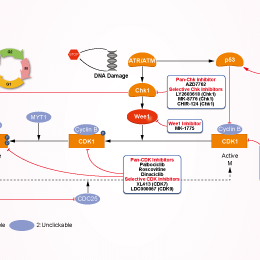
相关信号通路图
细胞实验数据示例
| 细胞系 | 实验类型 | 给药浓度 | 孵育时间 | 活性描述 | 文献信息(PMID) |
|---|---|---|---|---|---|
| CMY | Cell Viability Assay | 10-10000 nM | 72 h | reduces cell vialibity in a concentration-dependent manner | 24962331 |
| CMK | Cell Viability Assay | 10-10000 nM | 72 h | reduces cell vialibity in a concentration-dependent manner | 24962331 |
| MOLM-13 | Growth Inhibition Assay | 125/250/500 nM | 48 h | increases cell death in a concentration-dependent manner | 25084614 |
| OCI-AML3 | Growth Inhibition Assay | 125/250/500 nM | 48 h | increases cell death in a concentration-dependent manner | 25084614 |
| HL-60 | Growth Inhibition Assay | 125/250/500 nM | 48 h | increases cell death in a concentration-dependent manner | 25084614 |
| U937 | Growth Inhibition Assay | 125/250/500 nM | 48 h | increases cell death in a concentration-dependent manner | 25084614 |
| MV4-11 | Growth Inhibition Assay | 125/250/500 nM | 48 h | increases cell death in a concentration-dependent manner | 25084614 |
| THP-1 | Growth Inhibition Assay | 125/250/500 nM | 48 h | increases cell death in a concentration-dependent manner | 25084614 |
| SK-N-DZ | Apoptosis Assay | 500 nM | 48 h | induces cell apoptosis | 25308916 |
| SK-N-AS | Apoptosis Assay | 500 nM | 48 h | induces cell apoptosis | 25308916 |
| IST-MES1 | Cell Viability Assay | 150/250 nM | 72 h | enhances the cisplatin cytotoxic effect in a concentration-dependent manner | 24365782 |
| IST-MES2 | Cell Viability Assay | 150/250 nM | 72 h | enhances the cisplatin cytotoxic effect in a concentration-dependent manner | 24365782 |
| REN | Cell Viability Assay | 150/250 nM | 72 h | enhances the cisplatin cytotoxic effect in a concentration-dependent manner | 24365782 |
| NCI-H2452 | Cell Viability Assay | 150/250 nM | 72 h | enhances the cisplatin cytotoxic effect in a concentration-dependent manner | 24365782 |
| MSTO-211H | Cell Viability Assay | 150/250 nM | 72 h | enhances the cisplatin cytotoxic effect in a concentration-dependent manner | 24365782 |
| NCI-H2052 | Cell Viability Assay | 150/250 nM | 72 h | enhances the cisplatin cytotoxic effect in a concentration-dependent manner | 24365782 |
| T98G | Apoptosis Assay | 100/250 nM | 6 h | enhances radiation-induced cell killing | 21992793 |
| A549 | Apoptosis Assay | 200 nM | 1 h | radiosensitizes NSCLC cells in a p53-dependent manner | 21799033 |
| H460 | Apoptosis Assay | 200 nM | 1 h | radiosensitizes NSCLC cells in a p53-dependent manner | 21799033 |
| H1299 | Apoptosis Assay | 200 nM | 1 h | radiosensitizes NSCLC cells in a p53-dependent manner | 21799033 |
| Calu-6 | Apoptosis Assay | 200 nM | 1 h | radiosensitizes NSCLC cells in a p53-dependent manner | 21799033 |
| WiDr | Kinase Assays | 10-10000 nM | 8 h | inhibits phosphorylation of CDC2 at Tyr15 with an EC50 value of 85 nmol/L pretreated with gemcitabine | 19887545 |
| Function assay | MDA-MB-231 | 0.1 to 10 uM | 6 hrs | Inhibition of Wee1 in human MDA-MB-231 cells assessed as decrease in CDK1 phosphorylation at Tyr 15 at 0.1 to 10 uM after 6 hrs by Western blot method | 28792760 |
| Function assay | HEK293T | 0.1 to 10 uM | 6 hrs | Inhibition of Wee1 in HEK293T cells assessed as decrease in CDK1 phosphorylation at Tyr15 at 0.1 to 10 uM after 6 hrs by Western blot method | 28792760 |
| Function assay | HEK293T | 0.1 to 10 uM | 6 hrs | Inhibition of PLK1 in HEK293T cells assessed as decrease in TCTP phosphorylation at 0.1 to 10 uM after 6 hrs by Western blot method | 28792760 |
| Function assay | MDA-MB-23 | 0.1 to 10 uM | 6 hrs | Inhibition of PLK1 in human MDA-MB-23 cells assessed as decrease in TCTP phosphorylation at 0.1 to 10 uM after 6 hrs by Western blot method | 28792760 |
| Antiproliferative assay | MDA-MB-231 | 72 hrs | Antiproliferative activity against human MDA-MB-231 cells measured after 72 hrs by CellTiter-Blue assay, IC50 = 0.26 μM. | 28792760 | |
| Antiproliferative assay | HEK293T | 72 hrs | Antiproliferative activity against HEK293T cells measured after 72 hrs by CellTiter-Blue assay, IC50 = 0.29 μM. | 28792760 | |
| Antiproliferative assay | MM1S | 72 hrs | Antiproliferative activity against human MM1S cells measured after 72 hrs by CellTiter-Blue assay, IC50 = 0.31 μM. | 28792760 | |
| Function assay | HEK293 | 1 hr | Inhibition of human full length PKMYT1 expressed in HEK293 cells using EFS (247 to 259 residues) as substrate after 1 hr by fluorescence polarization immunoasay, Ki = 0.47 μM. | 29941193 | |
| Function assay | HEK293 | 1 hr | Inhibition of human full length PKMYT1 expressed in HEK293 cells using EFS (247 to 259 residues) as substrate after 1 hr by fluorescence polarization immunoasay, IC50 = 4.94 μM. | 29941193 | |
| Dayo | Growth Inhibition Assay | IC50=150 nM | 24661910 | ||
| SK-N-DZ | Growth Inhibition Assay | IC50=0.36 ± 0.01 μM | 25308916 | ||
| SK-N-AS | Growth Inhibition Assay | IC50=0.50 ± 0.02 μM | 25308916 | ||
| SK-N-BE (2), MK→PAN | Growth Inhibition Assay | IC50=2.4 ± 0.3 μM | 25308916 | ||
| SK-N-BE (2), PAN→MK | Growth Inhibition Assay | IC50=26.6 ± 9.6 μM | 25308916 | ||
| SK-N-BE (2) | Growth Inhibition Assay | IC50=2.4 ± 0.3 μM | 25308916 | ||
| PANC-1 | Growth Inhibition Assay | IC50=10.6 ± 1.1 μM | 25458954 | ||
| MIAPaCa-2 | Growth Inhibition Assay | IC50=0.5 ± 0.05 μM | 25458954 | ||
| HPAC | Growth Inhibition Assay | IC50=0.5 ± 0.01 μM | 25458954 | ||
| CFPAC-1 | Growth Inhibition Assay | IC50=3.3 ± 0.2 μM | 25458954 | ||
| BxPC-3 | Growth Inhibition Assay | IC50=0.8 ± 0.03 μM | 25458954 | ||
| ASPC-1 | Growth Inhibition Assay | IC50=13.2 ± 1.1 μM | 25458954 | ||
| UW228 | Growth Inhibition Assay | IC50=232 nM | 24661910 | ||
| WEE1 | Growth Inhibition Assay | IC50=5.2 nM | 23699655 | ||
| CDC2 | Growth Inhibition Assay | IC50>1000 nM | 23699655 | ||
| CDK7 | Growth Inhibition Assay | IC50>1000 nM | 23699655 | ||
| MYT1 | Growth Inhibition Assay | IC50=530 nM | 23699655 | ||
| Function assay | Expi293F | Binding affinity to recombinant human full-length N-terminal His8-tagged Wee1 (1 to 646 residues) expressed in human Expi293F cells assessed as dessociation constant by quantitative real-time PCR method, Kd = 0.0032 μM. | 28792760 | ||
| Function assay | Expi293F | Binding affinity to recombinant human full-length N-terminal His8-tagged Wee2 (1 to 567 residues) expressed in human Expi293F cells assessed as dessociation constant by quantitative real-time PCR method, Kd = 0.0039 μM. | 28792760 | ||
| qHTS assay | TC32 | qHTS of pediatric cancer cell lines to identify multiple opportunities for drug repurposing: Primary screen for TC32 cells | 29435139 | ||
| qHTS assay | U-2 OS | qHTS of pediatric cancer cell lines to identify multiple opportunities for drug repurposing: Primary screen for U-2 OS cells | 29435139 | ||
| qHTS assay | A673 | qHTS of pediatric cancer cell lines to identify multiple opportunities for drug repurposing: Primary screen for A673 cells | 29435139 | ||
| qHTS assay | DAOY | qHTS of pediatric cancer cell lines to identify multiple opportunities for drug repurposing: Primary screen for DAOY cells | 29435139 | ||
| qHTS assay | Saos-2 | qHTS of pediatric cancer cell lines to identify multiple opportunities for drug repurposing: Primary screen for Saos-2 cells | 29435139 | ||
| qHTS assay | BT-37 | qHTS of pediatric cancer cell lines to identify multiple opportunities for drug repurposing: Primary screen for BT-37 cells | 29435139 | ||
| qHTS assay | RD | qHTS of pediatric cancer cell lines to identify multiple opportunities for drug repurposing: Primary screen for RD cells | 29435139 | ||
| qHTS assay | SK-N-SH | qHTS of pediatric cancer cell lines to identify multiple opportunities for drug repurposing: Primary screen for SK-N-SH cells | 29435139 | ||
| qHTS assay | BT-12 | qHTS of pediatric cancer cell lines to identify multiple opportunities for drug repurposing: Primary screen for BT-12 cells | 29435139 | ||
| qHTS assay | NB1643 | qHTS of pediatric cancer cell lines to identify multiple opportunities for drug repurposing: Primary screen for NB1643 cells | 29435139 | ||
| qHTS assay | OHS-50 | qHTS of pediatric cancer cell lines to identify multiple opportunities for drug repurposing: Primary screen for OHS-50 cells | 29435139 | ||
| qHTS assay | BT-12 | qHTS of pediatric cancer cell lines to identify multiple opportunities for drug repurposing: Confirmatory screen for BT-12 cells | 29435139 | ||
| qHTS assay | DAOY | qHTS of pediatric cancer cell lines to identify multiple opportunities for drug repurposing: Confirmatory screen for DAOY cells | 29435139 | ||
| qHTS assay | SK-N-SH | qHTS of pediatric cancer cell lines to identify multiple opportunities for drug repurposing: Confirmatory screen for SK-N-SH cells | 29435139 | ||
| qHTS assay | Rh41 | qHTS of pediatric cancer cell lines to identify multiple opportunities for drug repurposing: Primary screen for Rh41 cells | 29435139 | ||
| qHTS assay | A673 | qHTS of pediatric cancer cell lines to identify multiple opportunities for drug repurposing: Confirmatory screen for A673 cells) | 29435139 | ||
| qHTS assay | MG 63 (6-TG R) | qHTS of pediatric cancer cell lines to identify multiple opportunities for drug repurposing: Confirmatory screen for MG 63 (6-TG R) cells | 29435139 | ||
| qHTS assay | U-2 OS | qHTS of pediatric cancer cell lines to identify multiple opportunities for drug repurposing: Confirmatory screen for U-2 OS cells | 29435139 | ||
| qHTS assay | OHS-50 | qHTS of pediatric cancer cell lines to identify multiple opportunities for drug repurposing: Confirmatory screen for OHS-50 cells | 29435139 | ||
| qHTS assay | Rh41 | qHTS of pediatric cancer cell lines to identify multiple opportunities for drug repurposing: Confirmatory screen for Rh41 cells | 29435139 | ||
| qHTS assay | RD | qHTS of pediatric cancer cell lines to identify multiple opportunities for drug repurposing: Confirmatory screen for RD cells | 29435139 | ||
| qHTS assay | SJ-GBM2 | qHTS of pediatric cancer cell lines to identify multiple opportunities for drug repurposing: Primary screen for SJ-GBM2 cells | 29435139 | ||
| qHTS assay | SK-N-MC | qHTS of pediatric cancer cell lines to identify multiple opportunities for drug repurposing: Primary screen for SK-N-MC cells | 29435139 | ||
| qHTS assay | NB-EBc1 | qHTS of pediatric cancer cell lines to identify multiple opportunities for drug repurposing: Primary screen for NB-EBc1 cells | 29435139 | ||
| qHTS assay | LAN-5 | qHTS of pediatric cancer cell lines to identify multiple opportunities for drug repurposing: Primary screen for LAN-5 cells | 29435139 | ||
| qHTS assay | Rh18 | qHTS of pediatric cancer cell lines to identify multiple opportunities for drug repurposing: Primary screen for Rh18 cells | 29435139 | ||
| qHTS assay | SJ-GBM2 | qHTS of pediatric cancer cell lines to identify multiple opportunities for drug repurposing: Confirmatory screen for SJ-GBM2 cells | 29435139 | ||
| qHTS assay | Saos-2 | qHTS of pediatric cancer cell lines to identify multiple opportunities for drug repurposing: Confirmatory screen for Saos-2 cells | 29435139 | ||
| 点击查看更多细胞系数据 | |||||
生物活性
| 产品描述 | Adavosertib (MK-1775, AZD1775)是一种有效的,高选择性Wee1抑制剂,无细胞试验中IC50为5.2 nM;阻碍G2期DNA损伤检验点。Phase 2。 | ||
|---|---|---|---|
| 特性 | 首个报道的 Wee1抑制剂。 | ||
| 靶点 |
|
| 体外研究(In Vitro) | ||||
| 体外研究活性 | MK-1775以ATP竞争的方式抑制Wee1激酶。与作用于Wee1相比,MK-1775对Yes的效能低2-到3-倍,IC50为14 nM,对7种其他激酶的效能低10倍,1 μM浓度下抑制率>80%,比对人Myt 1选择性高100倍以上,并抑制周期蛋白依赖性激酶1 (CDC2) 在可选择位点(Thr14) 的磷酸化作用。通过阻断负荷突变型p53的WiDr细胞中Wee1活性,废止DNA损伤检控点,MK-1775治疗抑制Tyr15 (CDC2Y15)位点的CDC2基础磷酸化作用,EC50为49 nM,并剂量依赖性抑制诱导的CDC2磷酸化和细胞周期阻滞,EC50分别为82 nM和81 nM,180 nM 和163 nM,以及159 nM 和 160 nM。30-100 nM 的MK-1775单独治疗在WiDr 和 H1299细胞中没有显著的抗增殖作用,而300 nM的MK-1775足以抑制>80%的Wee1,表现出温和但显著的抗增殖作用,在WiDr和H1299细胞中抑制率分别为34.1%和28.4%。 |
|||
|---|---|---|---|---|
| 激酶实验 | 体外激酶试验 | |||
| 使用重组人Wee1。激酶反应使用10 μM ATP,1.0 μCi of [γ-33P]ATP,和2.5 μg poly(Lys, Tyr)作为底物,在逐渐增加浓度的MK-1775存在下,在30°C环境中进行30分钟。整合到底物的放射性被捕获到MultiScreen-PH平板,在液体闪烁计数器上计数。 | ||||
| 细胞实验 | 细胞系 | WiDr,NCI-H1299,TOV21G,和 HeLa细胞 | ||
| 浓度 | 在DMSO中溶解,终浓度为~10 μM | |||
| 孵育时间 | 24小时 | |||
| 方法 | 细胞处理24小时,然后用MK-1775再处理24小时。细胞活性使用SpectraMax通过WST-8试剂盒测定。细胞内caspase-3/7活性使用Caspase-3/7 Glo试剂盒测定。 |
|||
| 实验图片 | 检测方法 | 检测指标 | 实验图片 | PMID |
| Western blot | p-Cdk1(Y15) / Cdk1 p-KAP1(S824) / p-Chk2(T68) / p-Chk1(S345) PARP / CF-PARP / pH3(S10) / p-CDC25c(S216) / p-CDK2(Y15) WEE1 |

|
25609063 | |
| Immunofluorescence | tubulin / p-HH3(S10) γH2AX Cleaved caspase-3 / pH3 |
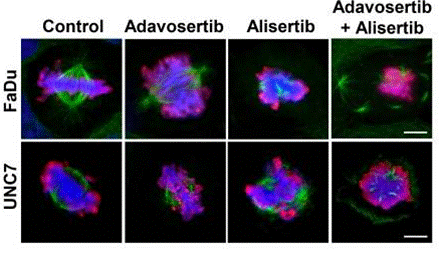
|
30755439 | |
| Growth inhibition assay | Cell viability IC50 |

|
25458954 | |
| 体内研究(In Vivo) | ||
| 体内研究活性 | MK-1775(~20 mg/kg)单独治疗对WiDr异种移植物表现出最小的抗肿瘤作用,在大鼠体内第3天时T/C为69%。在裸鼠HeLa-luc和TOV21G-shp53异种移植模型中,MK-1775单独的抗肿瘤效能是温和的。 |
|
|---|---|---|
| 动物实验 | Animal Models | 负荷WiDr,HeLa-luc,或TOV21G-shp53肿瘤的免疫缺陷裸鼠(F344/NJcl-rnu) |
| Dosages | ~20 mg/kg/day | |
| Administration | 口服 | |
| NCT Number | Recruitment | Conditions | Sponsor/Collaborators | Start Date | Phases |
|---|---|---|---|---|---|
| NCT03253679 | Completed | Advanced Malignant Solid Neoplasm|Refractory Malignant Solid Neoplasm |
National Cancer Institute (NCI) |
January 16 2019 | Phase 2 |
| NCT03668340 | Active not recruiting | Uterine Cancer |
Dana-Farber Cancer Institute|AstraZeneca |
October 22 2018 | Phase 2 |
| NCT03028766 | Completed | Hypopharynx Squamous Cell Carcinoma|Oral Cavity Squamous Cell Carcinoma|Larynx Cancer |
University of Birmingham|AstraZeneca|Cancer Research UK |
June 22 2017 | Phase 1 |
|
化学信息&溶解度
| 分子量 | 500.6 | 分子式 | C27H32N8O2 |
| CAS号 | 955365-80-7 | SDF | Download Adavosertib (AZD1775, MK-1775) SDF |
| Smiles | CC(C)(C1=NC(=CC=C1)N2C3=NC(=NC=C3C(=O)N2CC=C)NC4=CC=C(C=C4)N5CCN(CC5)C)O | ||
| 储存条件(自收到货起) | |||
|
体外溶解度 |
DMSO : 100 mg/mL ( (199.76 mM) ;DMSO吸湿会降低化合物溶解度,请使用新开封DMSO) Water : Insoluble Ethanol : Insoluble |
摩尔浓度计算器 |
|
体内溶解配方 现配现用,请按从左到右的顺序依次添加,澄清后再加入下一溶剂 |
动物体内配方计算器 | |||||
实验计算
动物体内配方计算器(澄清溶液)
第一步:请输入基本实验信息(考虑到实验过程中的损耗,建议多配一只动物的药量)
mg/kg
g
μL
只
第二步:请输入动物体内配方组成(配方适用于不溶于水的药物;不同批次药物配方比例不同,请联系Selleck为您提供正确的澄清溶液配方)
% DMSO
%
% Tween 80
% ddH2O
%DMSO
%
计算结果:
工作液浓度: mg/ml;
DMSO母液配制方法: mg 药物溶于μL DMSO溶液(母液浓度mg/mL,注:如该浓度超过该批次药物DMSO溶解度,请先联系Selleck);
体内配方配制方法:取μL DMSO母液,加入μL PEG300,混匀澄清后加入μL Tween 80,混匀澄清后加入μL ddH2O,混匀澄清。
体内配方配制方法:取μL DMSO母液,加入μL Corn oil,混匀澄清。
注意:1. 首先保证母液是澄清的;
2.一定要按照顺序依次将溶剂加入,进行下一步操作之前必须保证上一步操作得到的是澄清的溶液,可采用涡旋、超声或水浴加热等物理方法助溶。
技术支持
在订购、运输、储存和使用我们的产品的任何阶段,您遇到的任何问题,均可以通过拨打我们的热线电话400-668-6834,或者技术支持邮箱tech@selleck.cn,直接联系到我们。我们会在24小时内尽快联系您。
如果有其他问题,请给我们留言。
* 必填项
常见问题及建议解决方法
问题 1:
How to prepare its methylcellulose solution? and how to prepare methylcellulose itself? Once make the solution, how should i keep it?
回答:
It is a suspension or emulsion in 0.5% methylcellulose, and it is ok to treat mice orally. It is recommended to dissolve methylcellulose in saline. It will take some time to dissolve methylcellulose, and you can vortex it for a while. The methylcellulose solution of this compound can be stored at 4°C for a week.


